Half your applicants can't take the job. Find out first.
Visa status, notice period, salary band, shift availability. None of it shows up in a resume, and all of it kills offers at the final stage. Qualifying questions ask the deal-breakers the moment someone applies, so only hireable candidates spend time in your pipeline.
- Wrong answer, instant polite knock-out, zero credits spent
- AI drafts the questions from your job description
- Verdicts logged on every report, so nobody re-asks the basics
Qualifying · applied 2 min ago
Auto-screenedCandidate notified politely, instantly. Zero credits spent.
0 credits
qualifying costs nothing, on any plan
214 → 96
a typical pile after knock-outs run
1 min
is all it adds to the candidate's application
100%
of survivors are actually hireable
How it works
Three steps, zero busywork
Pick your deal-breakers
Work permit, start date, salary range, working hours, licences. AI suggests a set from the job description; you keep what matters and set which answers disqualify.
Candidates answer first
The questions open the assessment. A disqualifying answer ends it there with a respectful message, before any test or interview starts.
Your pipeline stays clean
Knocked-out candidates land in Disqualified with the reason attached. Everyone else moves on, and their verdict table travels with them to the report.
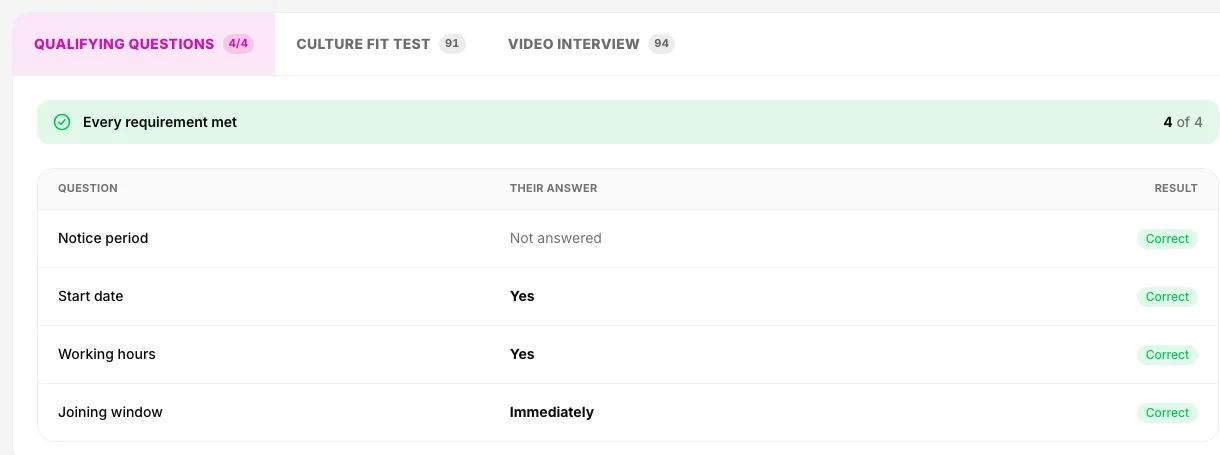
The report shows every requirement and the answer that met it. Nothing to re-check in the interview.
Why it works
The cheapest hour you will ever save
Deal-breakers cost nothing to ask
Qualifying questions run before credits are spent and before candidates invest time in tests. A candidate who cannot legally take the job finds out in minute one, not week three, and your credits go only to people you could hire.
Polite by design
A knock-out is not a rejection letter. Candidates get an immediate, respectful message that the role's requirements do not match, which beats the silence most applicants get from most companies. You control the wording.
Rules you set, not a black box
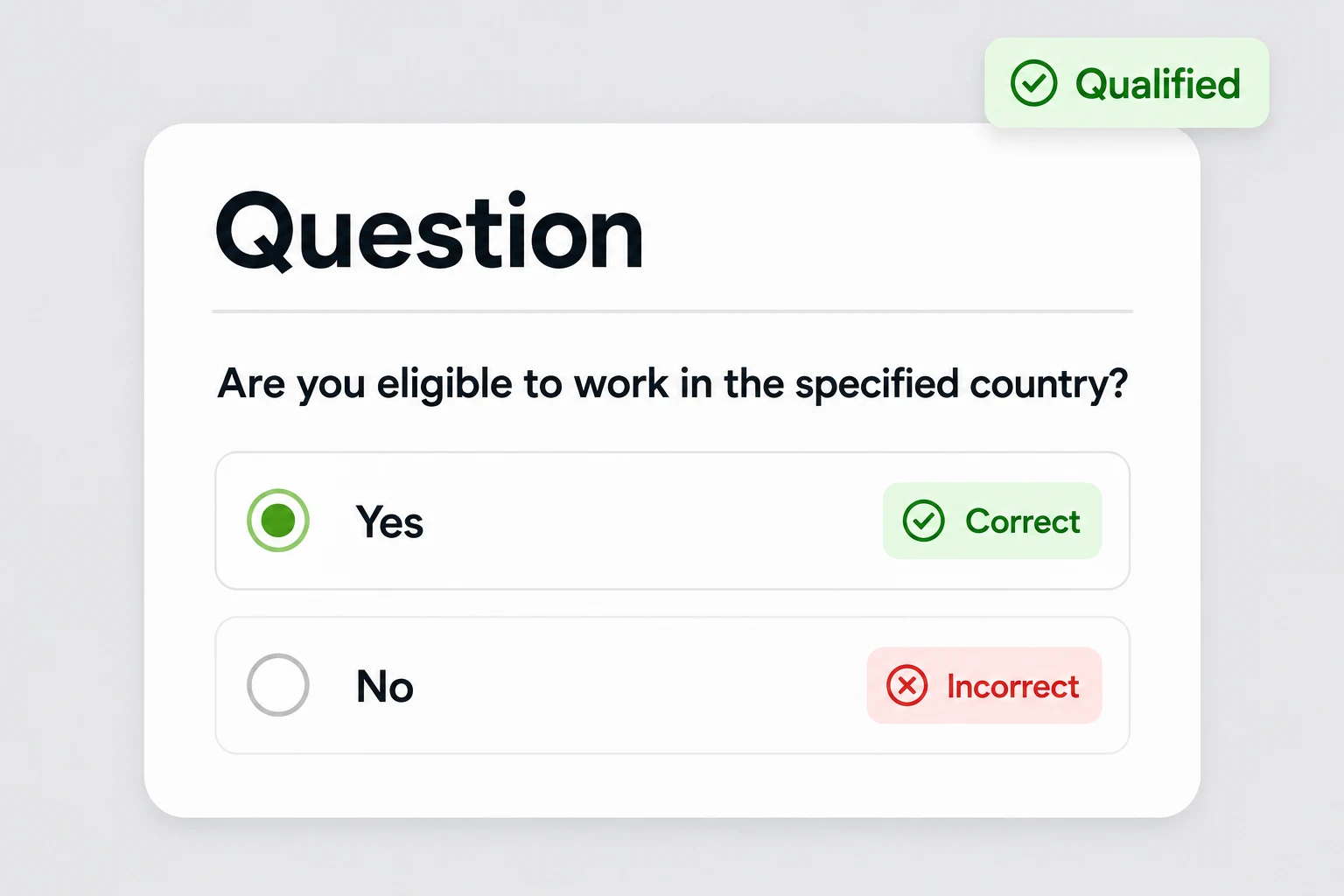
Every question has explicit disqualifying answers that you chose. There is no AI judgement here at all: a candidate who says no work permit is out because you said so, and the report records exactly that.
The interview starts further ahead
When a candidate reaches your calendar, their notice period, salary expectations and availability are already on the report as a verdict table. First calls start on substance, not logistics.
One assessment link
Mix it with the other five tools
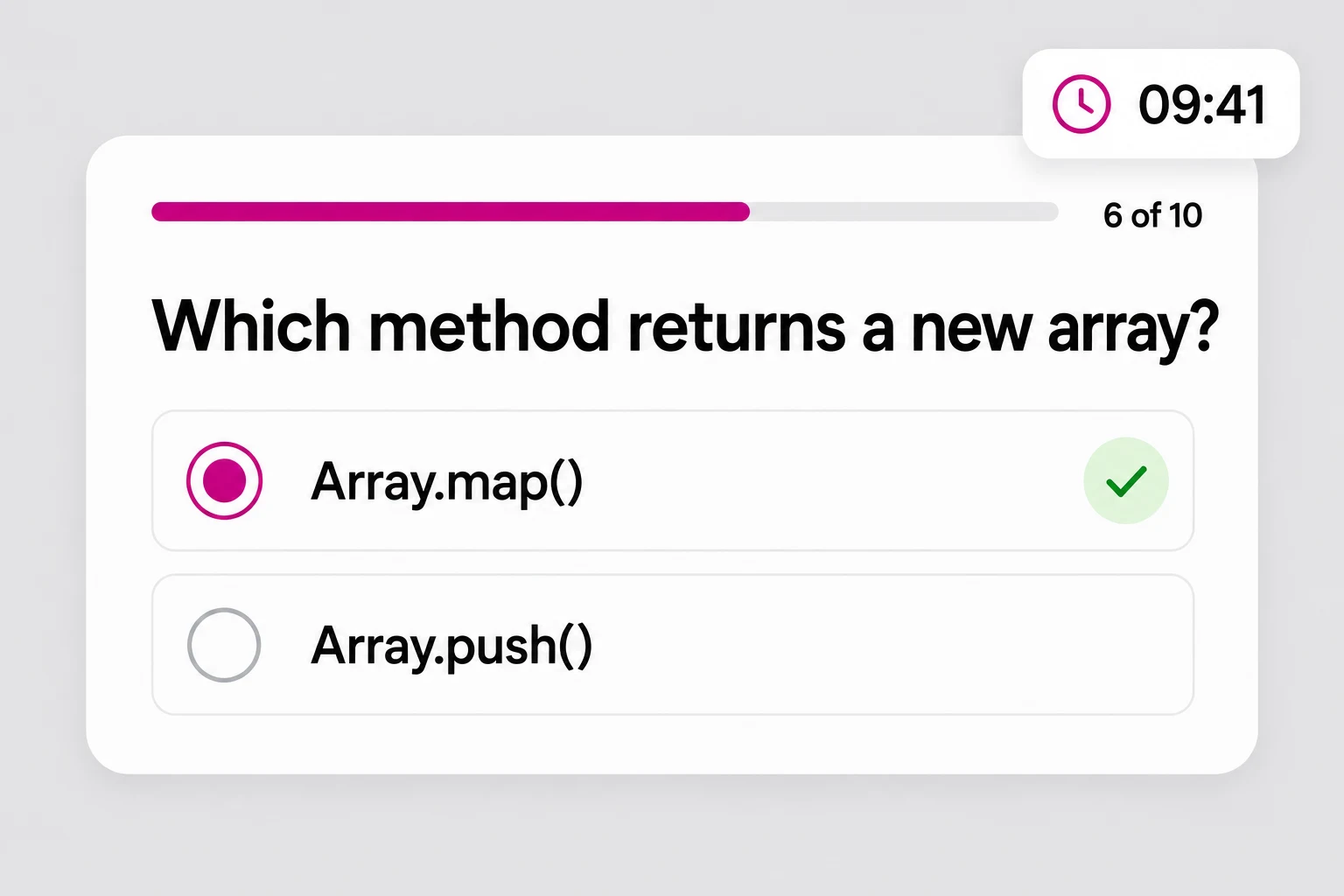
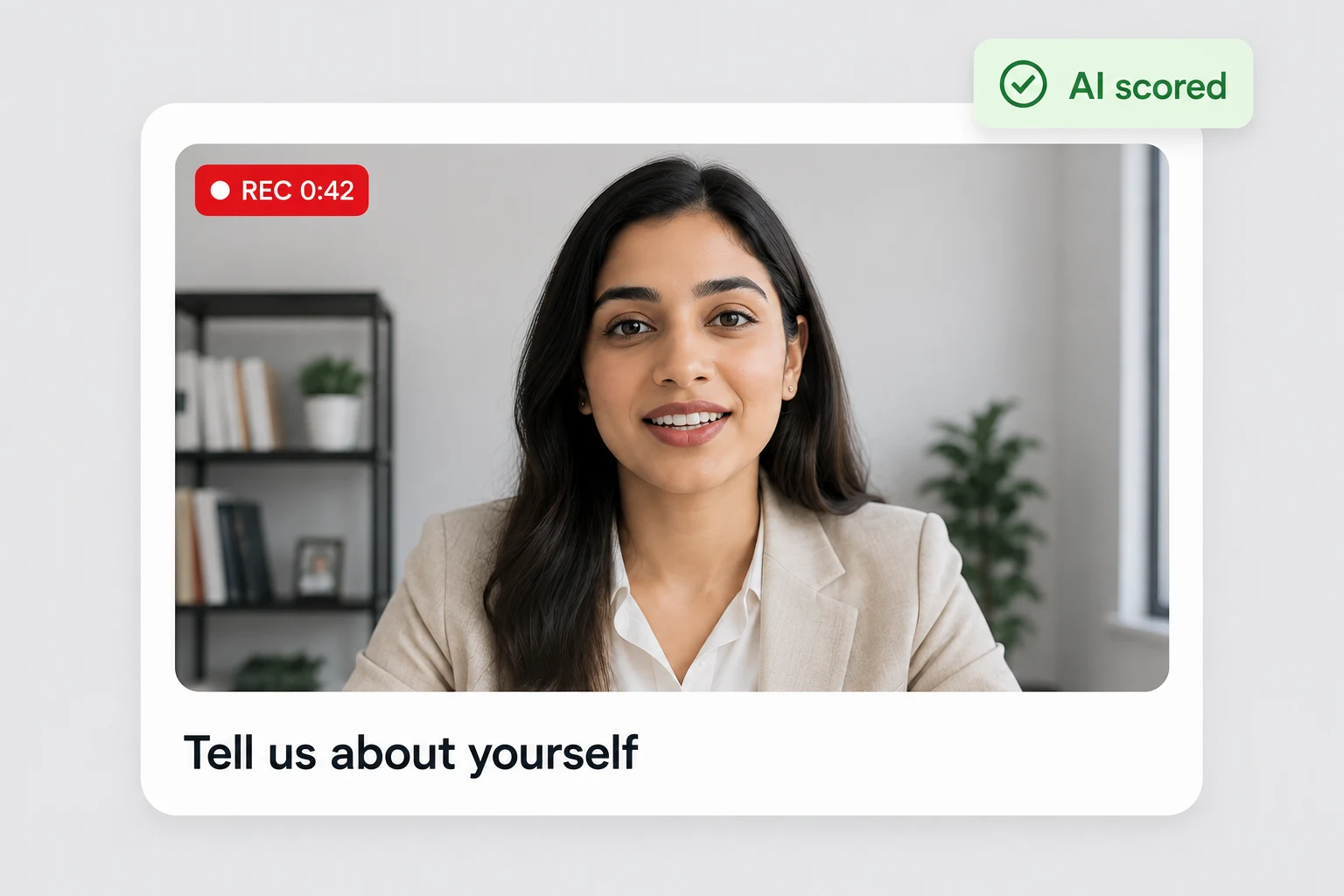
Candidates get a single link. Every signal lands on one ranked report per candidate.
Knockout questions, explained for the employer writing them
What knockout questions are, what they may and may not ask, why they run first at no cost, and how to write a set that holds up.
01What knockout questions are
Knockout questions are the short, factual questions a candidate answers at the very start of an application, before any test or interview. Each one has answers you have marked as disqualifying. A candidate who gives one of those answers is knocked out immediately, with a polite message, and never reaches the assessment. Everyone else continues, and their answers travel with them to the report as a verdict table. They are also called qualifying questions or candidate screening questions, and they are the only part of springhire that rejects anyone automatically. Every other tool, the skills tests, the one-way interview, resume scoring and the psychometric test, produces a score for a human to read. Knockout questions produce a yes or a no, on rules you wrote.
02What they should ask
Knockout questions should cover hard requirements of the job that a candidate either meets or does not. Work authorisation for the country the role is in. Notice period or earliest start date against the date you need someone. Availability for the shifts the role actually runs, including weekends or nights if those are real. Location or willingness to relocate, if the job cannot be done remotely. Licences and certifications the job legally requires, such as a driving licence or a professional registration. Salary expectation within the band you can pay. Each of these is a fact about the candidate that the resume rarely states and that ends the process at offer stage if it is wrong. Asking in minute one saves both sides the weeks in between.
03What they must not ask
Knockout questions must never touch protected characteristics: age, sex, race, religion, disability, marital or family status, pregnancy, sexual orientation, and anything that stands in for those. Do not ask when someone graduated as a proxy for age, or about childcare as a proxy for availability. Ask about the requirement itself: can you work the Saturday shift, yes or no. The rules on what an employer may ask differ between countries and sometimes between states or regions, so check local law before you publish a set of candidate screening questions, and have a second person read them. A good test is whether you would be comfortable showing the exact question and the disqualifying answer to the candidate who was knocked out by it. If not, rewrite it.
04Why they are free and run first
Knockout questions cost nothing on every plan, including the free plan, and they always run before anything else. Both facts follow from how credits work. A credit is spent only when a candidate completes an assessment, so a candidate knocked out at the first question has completed nothing and costs nothing. Running the questions first means the paid tools, the skills tests and interviews, are only ever taken by people you could legally and practically hire. It also respects the candidate. Someone without work authorisation finds out in a minute rather than after recording a twelve-minute interview. The order is fixed in the product: questions, then tests, then interview, then the report. You do not have to configure it.
05Writing them so they cannot be gamed
A knockout question can be gamed when the right answer is obvious and there is no cost to lying. Reduce both. Ask for specifics rather than agreement: the number of days of notice, not are you available soon; the salary figure, not is our range acceptable. Use ranges where a range is the real requirement, and make the range wide enough that an honest borderline answer is not punished. Avoid yes-no questions where a yes is plainly what you want, unless the requirement is genuinely binary, such as holding a licence. Tell candidates the answers will be checked, because they will be: the verdict table sits on the report and the interviewer sees it. A false answer on a hard requirement surfaces at reference or onboarding, and candidates know that.
06How they combine with tests and interviews
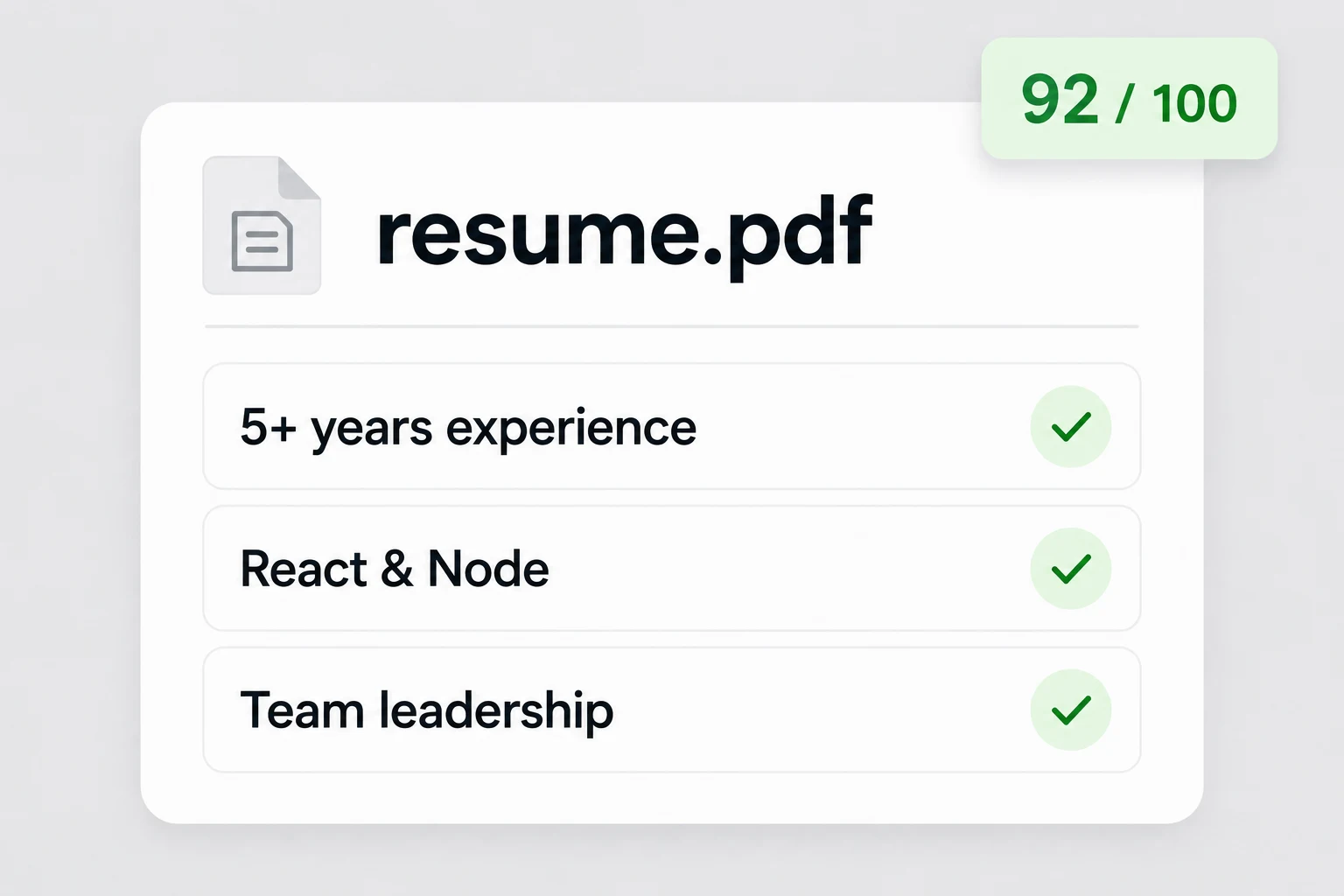
Knockout questions are the gate; tests and the one-way interview are the evidence. Once a candidate passes the questions, the same link carries them straight into whichever tools you added to the job: a skills test from the library at /test-library/, a recorded interview built at /one-way-interview/, resume scoring, the psychometric inventory. Nothing is sent separately and the candidate does not need an account. Every result lands on one report per candidate, with the knockout answers at the top as a verdict table, so when you open a shortlisted candidate you see the notice period and salary expectation before the scores. First calls then start on substance rather than logistics, because the logistics were settled in minute one.
07Letting the AI draft the set
You do not have to write the questions from scratch. Paste the job description and the AI drafts a starting set of candidate screening questions from the requirements it finds: a work permit if the role names a country, shift availability if it mentions weekends, a licence if the description requires one. You then delete what does not matter, edit the wording, and set which answers disqualify. The AI never sets a disqualifying answer for you, and it never adds a question about a protected characteristic. The draft is a time saver, not a decision maker. Read it with the same care as a set you wrote yourself, and check local law for the country the role is in before you publish.
08Reviewing the knocked-out list
Candidates who fail a knockout question land in a Disqualified list with the specific rule they failed attached. Look at that list before you look at the shortlist. If a large share of applicants failed the same question, either the job advert is attracting the wrong people or the rule is stricter than the job really is. Notice period is the usual culprit: a rule of fourteen days will knock out good candidates on a standard one-month notice who would have been fine if you had asked. A knocked-out candidate cannot retry on the same application, but you can re-invite them manually if the rule was wrong, and their new answers replace the old verdict. Reviewing the list once per job, early, is the cheapest fix in the whole process.
Frequently asked questions
Short knock-out questions candidates answer before an assessment starts: work permits, notice period, salary expectations, working hours, licences. Answers that fail the rules you set disqualify the candidate automatically and politely.
Yes. Qualifying questions cost zero credits on every plan, including the free plan. They exist so the paid tools only run on candidates you could actually hire.
Candidates get an immediate message that the role's requirements do not match their answers. You control the wording; the default is respectful and does not disclose the specific rule.
Not on the same application. If circumstances change, you can re-invite them manually and their new answers replace the old verdict.
Multiple choice with disqualifying options, numbers with acceptable ranges (salary, notice days), and yes-no requirements. AI drafts a starting set from your job description in seconds.
Your next shortlist, on autopilot
Tests, interviews and resume scoring in one link. AI hands you a ranked shortlist.
Get started freeFree plan included. No credit card needed.